Here is a version of our poetic from youtube:
Wednesday, 21 November 2012
Presenting the Poetic
Over the week/ weekend our sound man and our editor worked with our director to complete the poetic doc. We presented it yesterday. The feedback we got was largely positive, everyone thought it looked cinematic and worked really well. There were a few issues with the sound but they are easily fixed. Overall I am really happy with the way it turned out. I would have like there to be more contrast between the start and end as far as motion and editing speed is concerned but within the 2 min piece it was always going to be difficult to have a large development in style.
Here is a version of our poetic from youtube:
Here is a version of our poetic from youtube:

Shooting and sound documentary workshop
In our shooting and sound workshops we looked at two separate ways of shooting and recording sound, in a constructed environment, and on the go. To do this we mocked up an interview on graffiti and recorded our editor drawing and walking whilst being interviewed. From this I learned that if we were to do something similar in our project it would be best to use some kind of track or steadycam or at least practice the camera movements before recording the subject for real.
In the other half of the lesson we looked at how to record in a set or house and the things that can effect it. We talked about positioning of the camera, the subject, the interviewer and of the background, including windows and doors. These offered good insights and tips into filming interviews that will help to make our work look professional. The tip he gave to us specifically was about masking our subjects. He suggested we just set the exposure to match the outside and then film them infront of a large window, turning them into a silhouette.
In the other half of the lesson we looked at how to record in a set or house and the things that can effect it. We talked about positioning of the camera, the subject, the interviewer and of the background, including windows and doors. These offered good insights and tips into filming interviews that will help to make our work look professional. The tip he gave to us specifically was about masking our subjects. He suggested we just set the exposure to match the outside and then film them infront of a large window, turning them into a silhouette.
Wednesday, 14 November 2012
Doc Shooting Day 2+3
We have been shooting our poetic doc for the last few days at Stanley Tools, here is my shot list for the shooting days:
So how did it go? Really well, the lighting was a lot better, much more helpful, and we had lots more time with the urbexers to get more relevant footage. We were a little restricted on the first day as the Airsofters that us the pace were using a few of the rooms however we got to move about during different times of the day so that was great. On the second day we were a little short on time but we had long enough to get the last few shots we needed so it went really well. After the first day me and Steve, the director, reviewed alll of the footage we has shot and were really happy with what it all looked like, we used the final day to get the last few shots noticed we needed and wrapped yesterday.


X
|
#
|
SHOT
|
Action
|
Notes
|
S.
|
1
|
MED
|
Urbexers go down the stairs
|
Ariel shot
|
2
|
|
2
|
CU
|
Silhouette goes past round window
|
Expos for outside
|
2
|
|
3
|
MED
|
Urbexer walks from behind cam into darkness
|
2
|
||
4
|
MED
|
Urbexer walks from darkness over cam
|
Opposite of sh3
|
2
|
|
5
|
CU
|
Aaron with cam in front of face
|
Background should be 1 point perspective
|
3
|
|
6
|
CU
|
Aaron with cam in front of face
|
Background should play on square motif
|
3
|
|
7
|
LONG
|
Aaron Defacing a window. Shot from behind him to hide
identity.
|
Try exposing for outside and inside lighting
|
3
|
|
8
|
MED
|
Track of urbexers looking at graffiti timed cam flash and
walk away
|
DOLLY
|
1/
3
|
|
9
|
LONG
|
Light version of chair and tv tracking shot
|
DOLLY
|
3
|
|
10
|
MED
|
Lighter shot Peacock graffiti or urbexers shooting the
graffiti
|
PAN
|
2
|
|
11
|
MCU
|
Tracking shot of the windows
|
DOLLY (like the practice shot)
|
2
|
|
12
|
LONG
|
Long shots of the large rooms, position urbexers CU and
LONG
|
One urbexer left+close
Other right+long
|
2/
3
|
|
13
|
MED
|
Bathroom, peeling walls and vegetation in better light
|
2
|
||
14
|
LONG
|
Shot of the outside of
|
Show the urbexers entering
|
2
|


Thursday, 25 October 2012
Bill Nichols Introduction to Documentary Chapter 2.
Bill Nichols’ Introduction
to Documentary offers many helpful insights into the world of documentary,
the second chapter titled, How Do Documentaries Differ from Other Types of
Film, describes the similarities and differences between Documentary and fictional
cinema. This chapter is broken down into three categories of differences,
institutional frameworks, communities of practitioners and audience reception.
Nichols also talks briefly about the ways in which movements developed
throughout documentary history, from this section I have noted some of the most
important defining qualities and points Nichols makes however this chapters
recounting of documentary history is rather sparse.
“ ‘Documentary” can be no more easily defined than “love” or
“culture”.” This whole chapter attempts however to describe the differences
between doc’ and fiction as well a working towards a definition of the “fuzzy”
genre of documentary. Many people have attempted to define documentary and one
thing most descriptions agree upon is that doc’ is a representation of reality
or as Nichols says “it is a representation of the world we already occupy.” One
of the interesting things Nichols points out about doc being a representation
is that “We judge a representation more by the nature of the pleasure it
offers, the value of the insight or knowledge it provides” this means that as
an audience “We ask more of a representation than we do of a reproduction”,
documentary strives to be more than a reproduction by using the rhetoric to
make a specific argument or show a specific point of view.
In
the sections in which Nichols talks about the institutional frameworks there
isn’t much of importance said, his logic is admittedly “circular” but does
still ring true that those films produced by documentary institutions, such as
the Discovery Chanel, will be documentaries. He does again address the
definition of documentary and its relationship with the “real”. The Documentary film maker John Grierson famously said that
documentary is "the creative treatment of actuality" however Nichols
states documentary must "also achieve a clarity or simplicity that implies
that documentaries achieve direct, truthful access to the real" as it is
"one of the prime attractions of the form". I believe this is one of the many key
conflicts for documentary film makers and one of the reasons it is such an
interesting genre to work in.
During
the section on documentary film makers themselves Nichols re asserts the same
circular logic, Documentary film makers make documentary films, however he
takes this one step further by highlighting the world in which documentary film
makers inhabit. Professional doc makers have a
language and common goal, they share distributors and meet at festivals and
have a certain shared identity.
The next section is “A corpus of texts” in which Nichols
describes documentary through different defining films, whilst doing this he
makes some interesting points about doc’ on the whole. Firstly Nichols brings
up the fact that documentary need not worry about continuity editing, rather
the editing within documentary is a kind of “evidentiary editing” which he
describes as shots cut and arranged “less by a
narrative organized around a central character than by a rhetoric organized
around a controlling logic or argument.” This seems to be one of the most
defining qualities of documentary as it ties into the idea of using rhetoric
language to make an argument, Nichols says it “not only furthers our
involvement in the unfolding of the film but supports the kinds of claims or
assertions the film makes about our world.” Also highlighted in this section,
and by the description of evidentiary editing, is the importance of the spoken
word within documentary, if the images are almost always used as evidence the point
they make and the actual historical or contextual argument is to be made up of
speech, Nichols puts it as “Speech fleshes out our sense of the world. An event
recounted becomes history reclaimed.” This is a somewhat victorious sounding
statement that shows the need for a strong spoken narrative within documentary.
Again however Nichols has again neglected to point out that the poetic
documentary often moves away from this convention, clearly as Nichols states
none of the defining factors of documentary can cover all documentaries hence
the “fuzziness” of the genre.
Nichols finishes this section by
talking about periods, movements and modes. Periods are specific times in which
documentaries changed or had specific identities, periods are simply the 30’s
or 60’s in which documentaries had particular flourishes. Movements arise from
“a group of films made by individual who share a common outlook or approach”,
these also tend to be placed in specific times or places. Finally Nichols’ own
creation, modes, are similar to movements but are more like genres within
documentary. Nichols states that modes are created "partly as a response
to perceived limitation in previous modes, partly as a response to
technological possibilities, and partly as a response to a changing social
context."
Finally Nichols’ discussion turns to the way audience see
and react to documentary an important relationship as Nichols rightly believes
“the sense that a film is a documentary lies in the mind of the beholder as
much as it lies in the films context or structure.” The indexical relationship between film and
reality is what Nichols talks about next however his over use of examples
outside of film and his general lack of explanation makes this section a little
muddled and over complicated, the final conclusion alone makes enough sense,
“Documentary re-presents the historical world by making an indexical
record of it; it represents the historical world by shaping this record
from a distinct perspective or point of view." Again Nichols
touches upon the separation between documents and documentaries, he states that
audiences expect to see the truth but that “the film
as a whole will stand back from being a pure document or transcription.” This
is a basic re iteration of what was said in the start of the chapter only this
time it is from the perspective of the audience not the film maker. Nichols
then extends this idea of representation and reality in what I think is one of
his most important statements “we anticipate the oscillation between
recognition of historical reality and the recognition of a representation about
it. This expectation distinguishes our involvement with documentary from our
involvement with other film genres.” It is a fairly simple statement but it is
one of the best ways to define documentary or to at least separate it from
fiction.
The importance and the popularity of documentary is
reinforced in the final few paragraphs of this second chapter as Nichols talks
about the “desire to know” or “epistephilia” that documentaries evoke in their
audiences and the sobriety documentary carries with it. No matter how they are
separated or how they are defined Nichols sums up the importance of documentary
by saying “They are the vehicles of action and intervention, power and knowledge,
desire and will, directed toward the world we physically inhabit and share.”
Bibliography
Nichols B. (2001). How do documentaries differ from other types of film. In: Introduction to documentary. usa: Indiana University Press. p20-41.
Wednesday, 24 October 2012
Bill Nichols' Introduction to Documentary Chapter 1
To improve my understanding of the documentary genre I have been reading Bill Nichols' "Introduction to Documentary" I have read the first chapter so far which gives a basic understanding of documentary principles and tackles some of the burning questions of documentary.
Nichols' book begins with an unusual statement, "Every film is a documentary". An odd thing to say at first but when you think of fictions as "documentaries of wish fulfilment", and normal documentaries as "social representation" it is a simple and beautiful idea that goes a long way to normalising the process of documentary structure, characters and storytelling. Documentary is difficult to define and Nichols doesn't particularly attempt to solve this with a simple definitions however he does say all things that are safe such as they represent what reality is, was or will be. One thing he does say that the aim of most doc's is to "convince us one view point is preferable to the others", as well as outlining the importance of this as it puts documentary over fiction when he says "We take not only pleasure from doc but direction as well." I think these statements definitely explain some of the popularity of doc's however poetic documentary seems to be outside of these aims.
The next large section is on the three ways Nichols believes Documentary engages with the world. The first of these is as with a "likeness or depiction of the world that bears a recognizable familiarity", this is pleasing because it helps the audience believe in the cinema, Nichols states "we see what was there before the camera; it must be true". He also acknowledges this is more of a cultural thing than a factual thing as images can clearly be altered during or after filming. Secondly "Documentaries stand for or represent the interests of others" and the others that it stands for or represents itself splits into three. Those that are the subject, those that sponsor the film and the directors own beliefs are all represented through one film. Thirdly and finally Documentary represents the world "in the same way a lawyer may represent his clients interests" as facts to make an argument for or against a specific point or a specific "view point ... preferable to the others".
The difficulties posed by representing others are next called into question by Nichols as he examines the ethics of documentary. Much of what he says is basic common sense and I think the mast interesting question posed isnt how should I represent people but how much about how I represent people should I tell them about? This is neatly confined to the issue of "informed consent" which allows film makers to have different levels of secrecy depending on the contract. Another of the interesting subjects Nichols touches upon in this section is the way filming people changes their actions in some way, the idea that this could ruin doc's is well battled with the idea that one of the points of doc's is to show how people act in front of camera and I believe this would be a fun idea to play with. The tension between film makers and subjects will always be high as Nichols explains subjects want to be shown in a flattering light however this isn't always the best for the film maker who has a career and reputation to make a living from, these arguments are clearly important to consider and the balance between a film makers wishes and keeping the subjects of the film or "social actors" happy appears to be one of the key aspects of obtaining a good documentary or at least an ethical one.
The rest of this first chapter is devoted to describing the "alliance" between the film maker, the audience and the subjects or social actors. He begins with a sentence that describes a common relation "I speak about them to you" he describes that an I is either a documentary film maker, usually with some kind of persona, or a voice of god type of narrator who from one perspective tells the audience a specific story or subject. The Them refers to a subject which can be expressed at both "What story shall I tell" or "What shall I talk about" two specific phrases which offer very different structures for different types of documentary. The you refers not only to the audience as a whole but to each single audience member as the specific person the film maker is addressing thus "activating" the audience. This is often done through rhetoric language which combines knowledge, poetry and narrative to construct a coherent argument. The sentences are thus "I speak about them to you" "It speaks about them or it to us" "I or We speak about us to you". I speak to them about you is pretty simple, it speaks about them or it to us however is much more about an unknown entity telling all audiences of something, to me these seem to be less documentaries and more info-mercials and adverts. We speak about us is again simple and deals with a group of people who express themselves and explore their own culture though documentary, this is also called "auto-ethnography".
The first chapter of Nichols' "Introduction to documentary" serves as a good introduction to some of the issues of documentary film making and offers some simplistic solutions to how to view documentary. From this introduction I have developed a list of questions to help me when I'm analysing documentary;
1. Which of Nichols' modes is it and does it fit well?
2. does it represent the world as a likeness or depiction of the world that bears a recognizable familiarity, or does it clearly take liberties and move away from a likeness we recognise.
3. Whose interests are represented (ie. the inquisitive public's)
4. What "case" is it Presenting. (ie. a mans struggle in harsh climate + a families strength((Rhetoric))
5. How does it use logic, narrative and poetic to for a cohesive rhetoric and what is this rhetoric?
6. How do representations of the subjects views relate to that of the film maker. Are they the same or different?
7. Is the doc fair and morale towards its subjects, was it ethical?
8. How does it treat the "three way" relationship?
9. Does is focus more on a story or more on talking about something?
10. How well rounded are "Them"? or are they just basic simple examples
11. Does the film activate us as audience members, making us want to pass on the news or make a change?
Hopefully these questions will help me implement some of the things I have learned from reading Nichols' first chapter of "Introduction to Documentary"
Bibliography
1. Nichols. (2001). Why are ethical issues central to documentary film making . In: Introduction to documentary. usa: Indiana University Press. p1-19.
Nichols' book begins with an unusual statement, "Every film is a documentary". An odd thing to say at first but when you think of fictions as "documentaries of wish fulfilment", and normal documentaries as "social representation" it is a simple and beautiful idea that goes a long way to normalising the process of documentary structure, characters and storytelling. Documentary is difficult to define and Nichols doesn't particularly attempt to solve this with a simple definitions however he does say all things that are safe such as they represent what reality is, was or will be. One thing he does say that the aim of most doc's is to "convince us one view point is preferable to the others", as well as outlining the importance of this as it puts documentary over fiction when he says "We take not only pleasure from doc but direction as well." I think these statements definitely explain some of the popularity of doc's however poetic documentary seems to be outside of these aims.
The next large section is on the three ways Nichols believes Documentary engages with the world. The first of these is as with a "likeness or depiction of the world that bears a recognizable familiarity", this is pleasing because it helps the audience believe in the cinema, Nichols states "we see what was there before the camera; it must be true". He also acknowledges this is more of a cultural thing than a factual thing as images can clearly be altered during or after filming. Secondly "Documentaries stand for or represent the interests of others" and the others that it stands for or represents itself splits into three. Those that are the subject, those that sponsor the film and the directors own beliefs are all represented through one film. Thirdly and finally Documentary represents the world "in the same way a lawyer may represent his clients interests" as facts to make an argument for or against a specific point or a specific "view point ... preferable to the others".
The difficulties posed by representing others are next called into question by Nichols as he examines the ethics of documentary. Much of what he says is basic common sense and I think the mast interesting question posed isnt how should I represent people but how much about how I represent people should I tell them about? This is neatly confined to the issue of "informed consent" which allows film makers to have different levels of secrecy depending on the contract. Another of the interesting subjects Nichols touches upon in this section is the way filming people changes their actions in some way, the idea that this could ruin doc's is well battled with the idea that one of the points of doc's is to show how people act in front of camera and I believe this would be a fun idea to play with. The tension between film makers and subjects will always be high as Nichols explains subjects want to be shown in a flattering light however this isn't always the best for the film maker who has a career and reputation to make a living from, these arguments are clearly important to consider and the balance between a film makers wishes and keeping the subjects of the film or "social actors" happy appears to be one of the key aspects of obtaining a good documentary or at least an ethical one.
The rest of this first chapter is devoted to describing the "alliance" between the film maker, the audience and the subjects or social actors. He begins with a sentence that describes a common relation "I speak about them to you" he describes that an I is either a documentary film maker, usually with some kind of persona, or a voice of god type of narrator who from one perspective tells the audience a specific story or subject. The Them refers to a subject which can be expressed at both "What story shall I tell" or "What shall I talk about" two specific phrases which offer very different structures for different types of documentary. The you refers not only to the audience as a whole but to each single audience member as the specific person the film maker is addressing thus "activating" the audience. This is often done through rhetoric language which combines knowledge, poetry and narrative to construct a coherent argument. The sentences are thus "I speak about them to you" "It speaks about them or it to us" "I or We speak about us to you". I speak to them about you is pretty simple, it speaks about them or it to us however is much more about an unknown entity telling all audiences of something, to me these seem to be less documentaries and more info-mercials and adverts. We speak about us is again simple and deals with a group of people who express themselves and explore their own culture though documentary, this is also called "auto-ethnography".
The first chapter of Nichols' "Introduction to documentary" serves as a good introduction to some of the issues of documentary film making and offers some simplistic solutions to how to view documentary. From this introduction I have developed a list of questions to help me when I'm analysing documentary;
1. Which of Nichols' modes is it and does it fit well?
2. does it represent the world as a likeness or depiction of the world that bears a recognizable familiarity, or does it clearly take liberties and move away from a likeness we recognise.
3. Whose interests are represented (ie. the inquisitive public's)
4. What "case" is it Presenting. (ie. a mans struggle in harsh climate + a families strength((Rhetoric))
5. How does it use logic, narrative and poetic to for a cohesive rhetoric and what is this rhetoric?
6. How do representations of the subjects views relate to that of the film maker. Are they the same or different?
7. Is the doc fair and morale towards its subjects, was it ethical?
8. How does it treat the "three way" relationship?
9. Does is focus more on a story or more on talking about something?
10. How well rounded are "Them"? or are they just basic simple examples
11. Does the film activate us as audience members, making us want to pass on the news or make a change?
Hopefully these questions will help me implement some of the things I have learned from reading Nichols' first chapter of "Introduction to Documentary"
Bibliography
1. Nichols. (2001). Why are ethical issues central to documentary film making . In: Introduction to documentary. usa: Indiana University Press. p1-19.
1st day shooting
The first day of shooting went quite well, it was a hard day, light conditions were pretty poor but we got to work at about 11 and spent the first 30mins getting settled. Me and our director, Steve went off with the camera to get working, we noted down which shots would work for each section of our poetic. Unfortunately our Urbexers were not available until 1500 ish so by then the light conditions had gone drastically down hill but we were there so we tried to get everything we could. I also had a lot of opportunities to use the dolly which was great fun and looked brilliant.
 This clip shows brief bits of the kind of footage we got:
Here are a few of my own personal comments on the work that will effect our next shoot and inform our future shot lists.
The first (practice shot) is good enough by itself. So get it without people in it
Graffiti would be good to get in the context of the room, not just abstract.
Expose for outside and inside on most shots.
Get peacock lighter
More 1 point perspective.
tracking shots work really well!
Chair reflections in better light.
Bathroom with more light
More of the urbexers doing their recording, it looks really nice.
Although that isnt all of the footage that gives a good idea of what we got, a lot of it is a little dark unfortunately but we are hoping to film more soon! I will be thinking of more shots and things over the next few days.

The first (practice shot) is good enough by itself. So get it without people in it
Graffiti would be good to get in the context of the room, not just abstract.
Expose for outside and inside on most shots.
Get peacock lighter
More 1 point perspective.
tracking shots work really well!
Chair reflections in better light.
Bathroom with more light
More of the urbexers doing their recording, it looks really nice.
Although that isnt all of the footage that gives a good idea of what we got, a lot of it is a little dark unfortunately but we are hoping to film more soon! I will be thinking of more shots and things over the next few days.
Friday, 19 October 2012
Research for shooting Stanley tools!
I have been looking at our location for the Urbexing documentary. The Stanley Tools building is an excellent location to start with and even though it would be great to get some more locations I have been looking into the location and the layout on some Urbexing sites. There are some amazing photographs around that highlight some beautifully desolate parts of the building that we will definitely search for on our reccie and when shooting.
After looking through photographs on multiple sites I found some interesting motifs and visuals to take advantage of in our poetic and final piece.
Firstly the amount of square imagery is staggering, here are a few photographs to show my point.


Another inspiring photograph I found was this:


After looking through photographs on multiple sites I found some interesting motifs and visuals to take advantage of in our poetic and final piece.
Firstly the amount of square imagery is staggering, here are a few photographs to show my point.


The floor panels, wall tiles and roofing are all square or rectangles and often have grid like appearances, I plan to use these squares as a visual motif throughout the Doc to make it visually interesting and use them to frame more important subjects.
As far as interesting things to frame are concerned the building is full of interesting bits of old office materials and things used by the company years ago. These items are awesome to look at but for us the most interesting things to shoot will be the Urbexers interactions with the items. Here are some of the things I mean


Another inspiring photograph I found was this:

To me this rabbit hole kind of perspective is really cool, it would be great to get a shot of our urbexers coming down this staircase as though the audience watching are following them down the rabbit hole into another world filled with abandonment and decay.
It is also nice to take a look at the outside of the building, this image shows that even on the outside the square imagery is inescapable, it would be silly not to use it.

There are also a lot of images of the city of Sheffield from the roof of the stanley tools building and its easy to see why, it looks amazing

I talked to Steve (our director) about the views from ontop of the building and we decided it would be best to capture it in a time lapse so that we see all the lights in the city come on. Although its a little bit irrelevant to our urbexing theme it is one of the most common pictures on the urbexing sites and is therefore important.
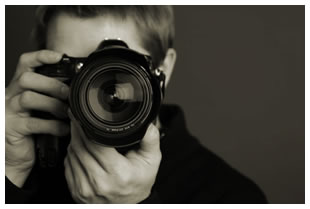
This final photograph is not of or related to Urbexing however it is an illustration of an idea I have for solving one of our shooting problems. Our contributors the urbexers, would rather not be fully on camera, we can get around this mainly by using selective focus, shadowing and quick cuts however I had another idea....
To shoot the Urbexers with their cameras in front of their faces, this solves the issue of identity but also adds meaning to the urbexers, it shows that they are seeing things through their cameras eye. They are here to photograph and that is how they see the locations and therefore to us they are photographers the cameras in
front of their faces is a nice visual representation of this.
These are the majority of the ideas I will be talking about in my pitch, I will have a section to myself in which I talk specifically about the imagery and camerawork I'm planning!
Photograph sources:
Subscribe to:
Posts (Atom)